Showing posts with label Pentax K-5. Show all posts

24 April 2014

A new toy...and what the mirror does afterwards

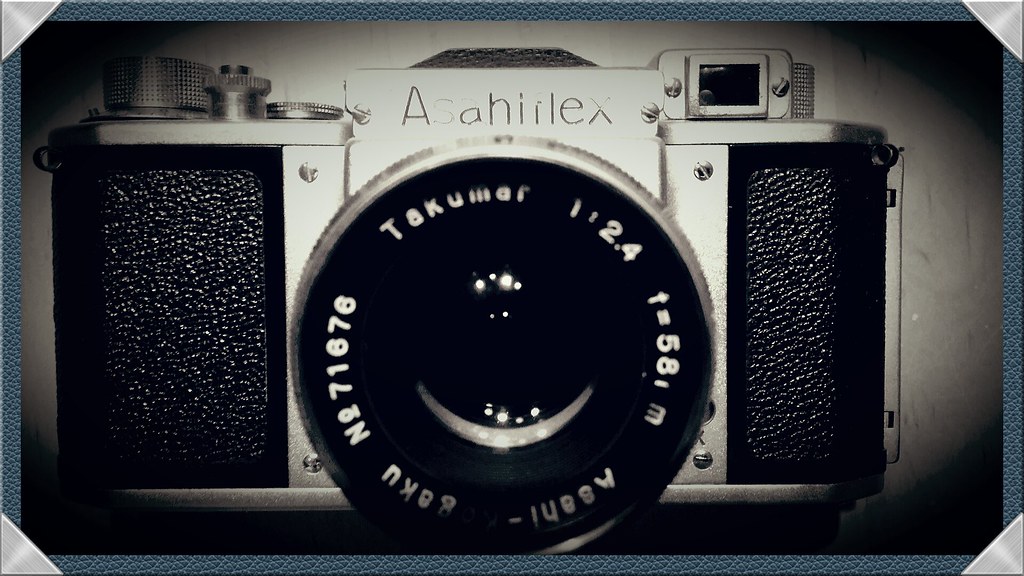
Asahiflex IIb with the Takumar f2.4 58mm lens.


I recently got hold of an Asahiflex IIb. I've wanted an Asahiflex for many years...and historically this may be the most significant one. I wanted to get a first hand impression of how it was to shoot with the ancestry cameras of the later Pentax SLRs. Always when I buy old cameras, it is not as much to collect them, as to get a first hand impression on how it was to use them, what the conditions was for past photographers. The first Asahiflex I from 1952 was the first single lens reflex (SLR) camera made in Japan. The owner of Asahi Optical Company (AOCo, later known as Pentax), Saburo Matsumoto, the niece of the AOCo founder Matsumoto Kajiwara, was stubornly aiming at producing a SLR camera rather than straight on copying pre-war German rangefinders like the Japanese camera giants back then (for example Konica, Canon, Nikon and Minolta). So far SLRs had several draw backs compared to rangefinders: focusing screens were not as bright, the mechanism was more complicated, and the mirror prevented wide-angle lenses from protruding into the camera body. It had however a great advantage compared to all other camera designs of the time: you saw the actual image that you were about to photograph, through the same lens as the picture would be taken,and you could focus, frame, and close down the lens based on that view. This is easy to forget in this age of digital cameras lacking optical viewfinders, just showing you the same image as the sensor captures live.
But up to 1955 the SLR had an aditional problem. When you shot, the viewfinder went black and stayed black because the mirror blocked the view. It stayed black until you forwarded the next frame, as the film crank action moved the mirror back to its original position. There were an early German Praktica camera where the mirror returned by itself, but not until you removed the finger from the shutter.
The man who deseigned the first Asahiflex was Nobuyuki Yoshida, whom then continued to work on solving the black-out of the SLRs. In 1954 came the Asahiflex IIb, with the first instant-return-mirror, the solution to the black-out-problem. A few years later came the Asahi Pentax (where "Pentax" was the name of that particular camera, not of the company or the brand), basically a Asahiflex IIb with a pentaprism and the m37 mount of the Asahiflexes replaced with an m42 mount. History was made, and within a few years the whole camera industry followed. Late-commers like Canon almost went broke for staying too long with rangefinders, and we entered the age when AOCo/Pentax sold more cameras than Canon and Nikon combined. In 1960 the Japanese Science and Technology Agency Directors Award was given to Mr. Yoshida and Mr. Matsumoto for the instant return mirror design.
Full page advertisement in Popular Photography in 1955 for the Asahiflex IIa, which shared the instant return mirror with the IIb, but was released a year later.
The lens on my Asahiflex is the more expensive normal lens alternative sold with the Asahiflexes: the Takumar f2.4 58mm, a Heliar type lens design with an extra cemented front element (making it a 5:3). Frank Mechelhoff believes it to be the fastest Heliar normal lens ever made. The name of the AOCo lenses (Takumar) are cause to some missunderstandings on the web. It comes from the younger brother of the AOCo founder, Takuma Kajiwara, who had left Japan when he was young and made a career as a portrait photographer and eventually also as a painter. So far, most web-sources have it right. What they miss is that this is also a name-game (from what I understand, the Jap's love when a word has more than one meaning). "Takuma" also means "grind" or "polish", as when you grind the glass to form a lens element, or when you polish the lens. The source to this is Takuma Kajiwara himself in an interview you can read on Pentax Forum where I've written much more on my research about Takuma Kajiwara: who was Takuma Kajiwara. Some web sources get it wrong when they claim that Takuma Kajiwara designed the early Takumar lenses. That honour goes instead to Mr. Ryohei Suzuki, the third member of the "Pentax-three" (Matsumoto, Yoshida and Suzuki). There is however signs that Takuma Kajiwara acted as sort of mentor (or older relative with insigts in the U.S. photography market) to his nephew Saburo Matsumoto, from when he spent more than a year in Japan in 1938-1939 after Matsumoto took over the familly company, to the 1950's when he helped promote the Asahiflex in the US. This in combination with the unresistable word-game I believe is enough explanation to why Matsumoto named the lenses "Takumar" (and it clearly wouldn't have worked to name them "Suzuki" after the lens designer when there were already a big Japanese company with that name).

I've got a roll of Ilford XP2 in the Asahiflex now to test it out, but mechanically everything seams to work as it is meant to. But I have not been able to resist putting the lens on my Pentax K-5 (using a m37-m42 adapter in combination with a m42-K mount adapter), all wide open, see below.

Finally, in case some reader have got an idea how to explain this: When AOCo went with a 37mm screw mount they took a very individualistic choice. No one else made cameras with that mount, and there were ever very few 3rd party manufacturers of m37 lenses. With the Asahi Pentax they changed to the 42 mm screw mount of Contax/Praktica, which was a sort of main stream choice (with the m42 mount and the exakta mounts being the only larger established SLR mounts). OK, that makes sence...they realised that there was good arguments for joining an excisting standard. But why is it that they use the same registration distance for the Asahiflex and the m37 lenses as did Zeiss/Contax/Praktica for the m42 mount (45.46mm)? They could have ended up with any registration distance between 40 and 50mm if they had been as independent in their choice as they were with the mount itself. This is somewhat of a mystery to me.

Test shots with the Takumar f2.4 58mm m37 on the Pentax K-5, all at f2.4:



15 August 2013

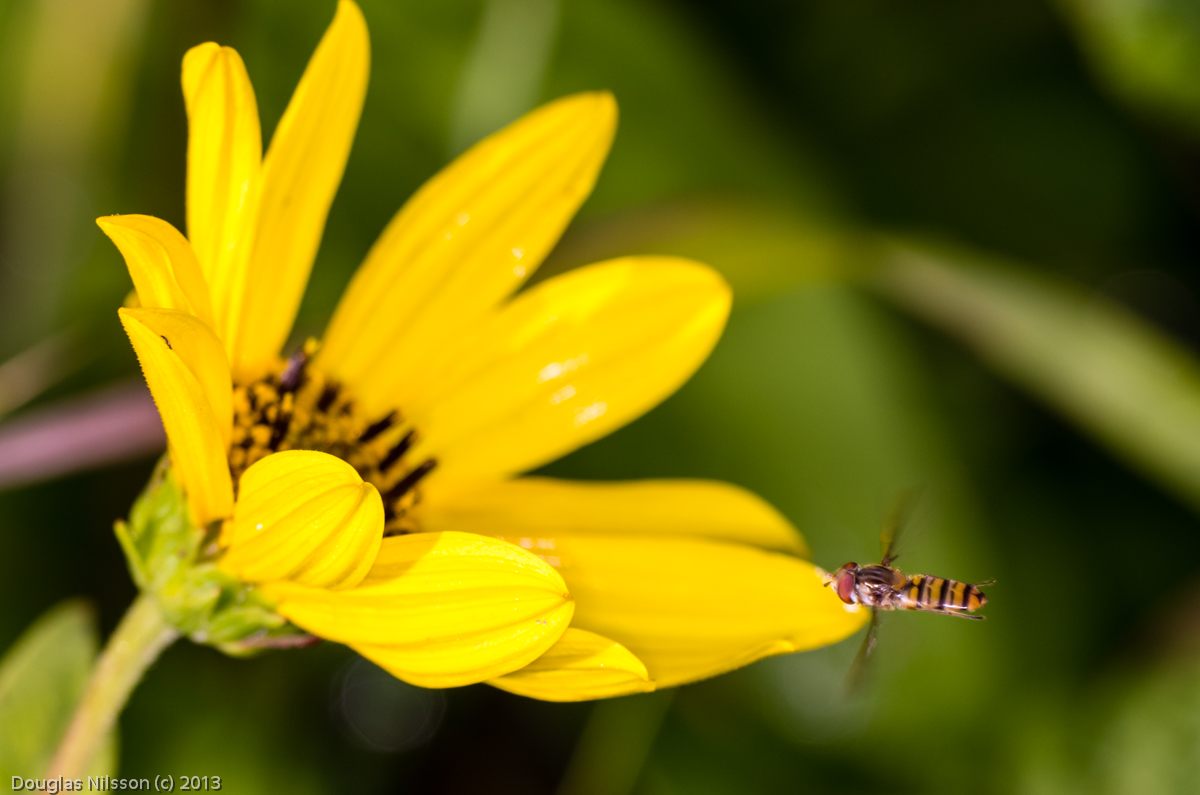
B.I.F. - Bug In Flight

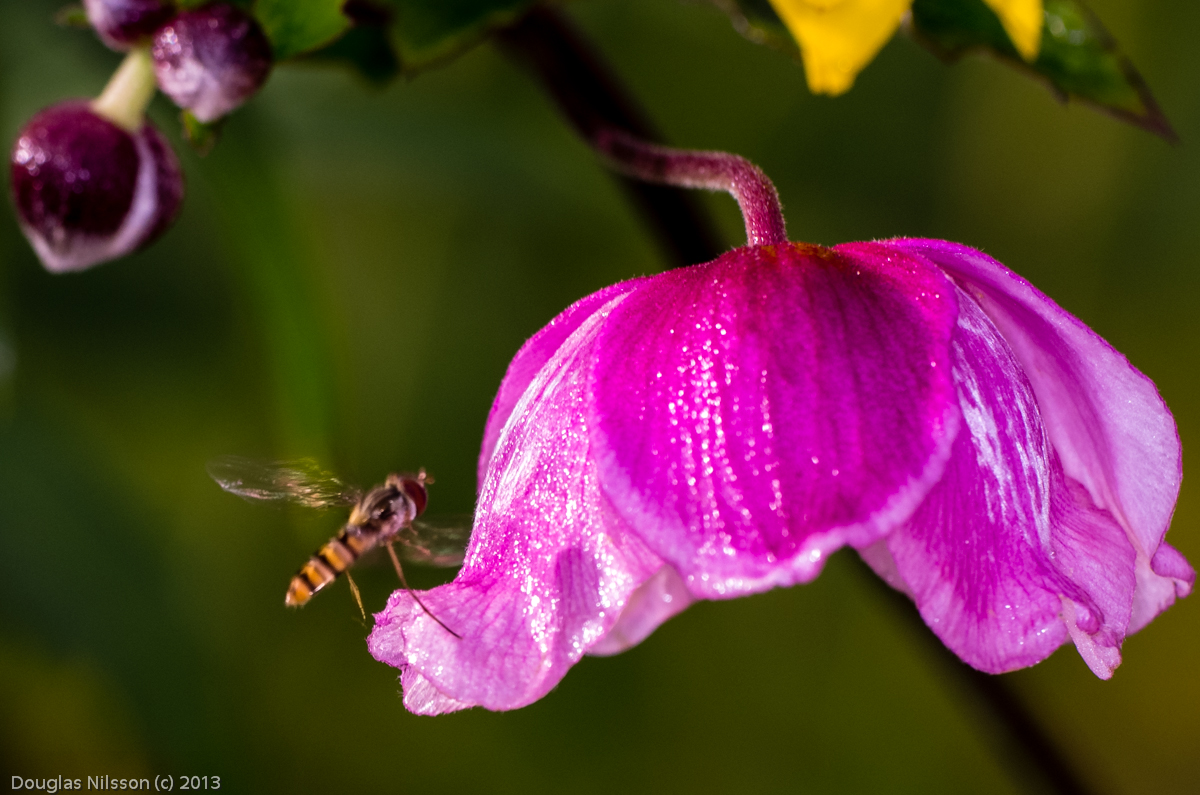
I think BIF originally means Bird In Flight, to capture a flying bird on photo. But catching a flying bug is just as difficult. Probably dragonflies are worst followed by butterflies. But the summer is already so late here that they are rare...so I'm practicing on hover flies.
Getting the bug inside the image frame and relatively sharp is difficult in itself. Then one have to plan composition and keep an eye on the background, preferably giving it a smooth bokeh in colors that contrast against the bug.
These images are taken with the Sigma 180mm macro and Pentax macro flash. For each shot I have of course erased many with the bug outside the DOF or even outside the image frame...but I am getting better.

12 August 2013

Metalic green fly

Most flies here are just black and boring, but sometimes I find these more photogenetic ones.

10 August 2013

If you were a 2 mm bug

If you were a bug just 2mm large, even a tiny flower is a whole world. I recon it is good to be a bit bigger than this. Yet, if it would fall from the flower, it would still survive. I would not survive a proportional fall. On the other hand, there are less things out there that may eat me...

Playing with a new macro lens in my own garden. Before it started to rain.


26 June 2013

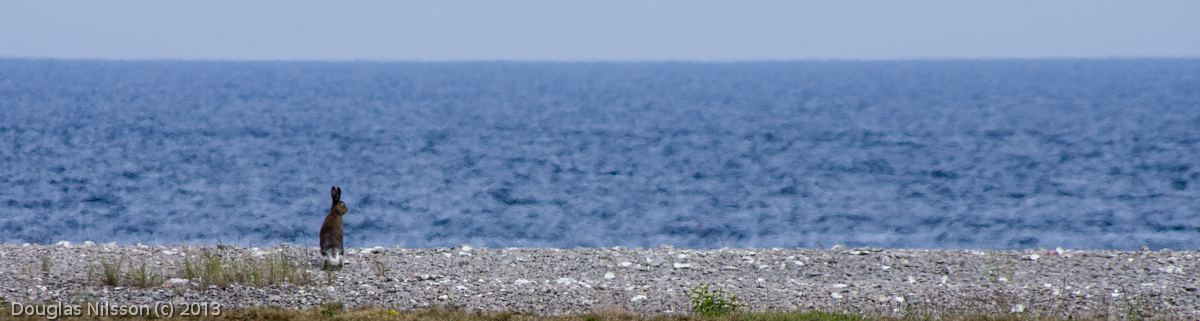
The hare and the sea (Haren och Havet)

The hare looked at the sea:
that blue flat is so large,
I can not eat it,
I can not drink it,
I can not run on it.
What is it for?


31 May 2013

Low light/high ISO performance of the Samsung NX20

As mentioned, I've realized quite soon that I had got spoiled by shooting with the Pentax K-5. Samsung NX is very far from the K-5 standard at high ISO. Now, the Samsing NX20 of course has a Samsung sensor. One that is presumably related to the Samsung sensor in the Pentax K20D and the Pentax K-7. Not exactly the same, but certainly related, perhaps like a niece or so ;)
People has claimed that they continued to improve the video functions since the K-7. I haven't tried that yet. I was hoping that they had also tweaked and improved other properties of the sensor. But my impression is that the K-7 does better, though I need to make a side by side comparison on the same motif, in the same light. It comes down to the nature of the noise. There is something with the NX20 noise at high ISO that I don't like!

Crop showing noise at ISO 6400 from the following photo.

Baristas at Stockholm Central Railwaystation. Uggly noise and even some banding :(


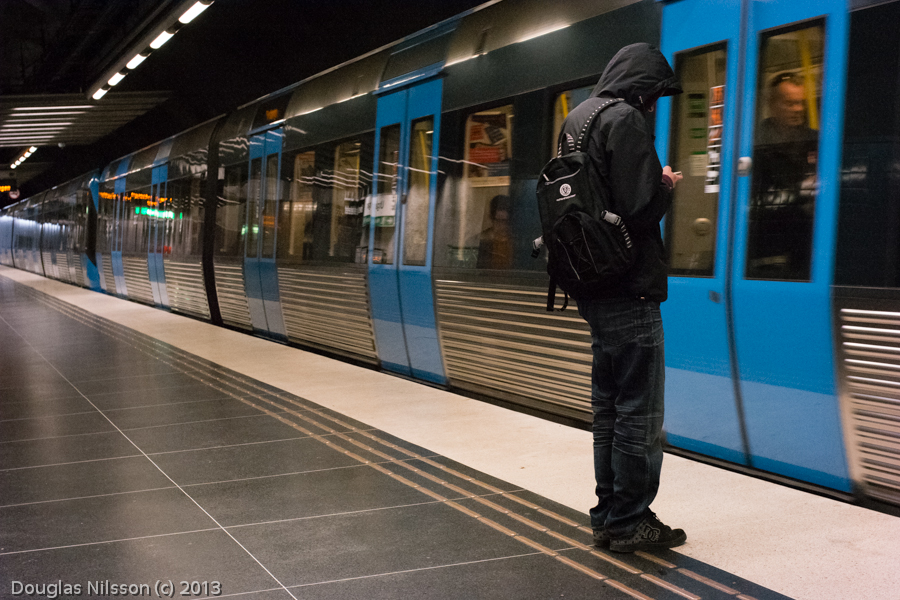
A more pleasing shot at ISO 6400 from the Stockholm sub-way yesterday. But then of course, there is more light in this shot, and high ISO always looks better when there is plenty of light, and then one could perhaps have shot it at lower ISO? Both shots were with the Konica Hexanon 40mm f1.8.

PentaxForums.com